Here is my new demo reel. It includes some some of my digital sculpting, character art work and game development. Please have a look!
2012-12 Demo reel from Matthew Board on Vimeo.
Wednesday, August 1, 2012

Monday, March 5, 2012
Game Education, Implicit Design, Earthquakes and a return to de Stijl
University of Twente, Creative Technology Program
Last night, I experienced my first earthquake ever while attending the Game Developers Conference. It was felt like a small tremor, nothing extreme, but to me, it somehow fits the theme of what a person experiences at the Game Developer’s conference. As the foundation of the earth moved underneath, conceptual pedagogical foundations of Interactive design and game development began shifting earlier last weekend and has somehow culminated in parallel shifts at the Game Education keynote this morning. Sounds crazy and doesn’t make a lot of sense, I know, but let me explain;
Earlier last week, I attended the Creative Technologies: Pedagogy and Applications, Applications & Creative Projects presentation by Angelika Mader and Dennis Reidsma from the University of Twente, The Netherlands. These educators were presenting Interactive works that had inherent, eloquent qualities of Dutch design dating back to de stijl and the practitioners that founded the movement. During the talk, it was interesting to see what was and was not identified as design by the audience. Some of the design decisions that were integrated into the curriculum were an encouragement toward play, single value design and implicit design.
Just this morning, I had to decide what talk I wanted to attend at the Game Developers conference. To me, the decision was obvious for two reasons. The first, the title was in German and included the word “kunst”, translated to English means “Art.” It seems that to most game designers, the word art carries with it mixed emotions. However, my background is in art, so the word has very different implications for me. The second, the person giving the talk was Professor Brian Moriarty from the Worcester Polytechnic Institute. I am very familiar with WPI from the time I spent living in Massachusetts and interacting with the IGDA community in the Boston area. I’ve also worked with WPI grads on a couple of projects. As such, I have an understanding of just how vital WPI is to the video game industry in Boston and at large and was excited to hear Professor Moriarty speak. In his presentation he showed Perlenspiel. A game engine he wrote to teach Digital Game Design 1. Professor Moriarty claimed he was searching for a “game clavier,” a common instrument that all game designers could use. Through this search, he developed Perlenspiel. I was so invigorated after the talk, and the association that were firing in my synapses, I had to immediately return to my hotel to write this blog post.
With this established, I would like to make clear that there were parallel undercurrents to both presentations that I want to bring to the fore. My purpose for this is to reveal to the reader my perception of how the parallel relationships emphasize the value in both presentations and highlight important topics in Interactive and game education.
The notion of play in early student projects was captivating because this is something that seems to be overlooked when students are faced with the monumental task of completing a degree to enter the workforce and when educators are faced with the daunting task paring down the multitude of skills, concepts and ideas associated with Interactive Media into a four year degree. However, the value in this notion of play was evident in the student works that presenting educators showed at the talk. For example, the students were using arduino boards to create physical computing project to communicate how many emails were in a person’s inbox. Though these assignments were not chocked full of content or aesthetic implications, they did give the students a few important skills for a young creative mind. The skills that I recognized were study and exploration through play. The idea of study or sketching is not a new idea to artists or designers, nor is the idea of exploration to find new ideas, processes or models. Both skills cultivate the young creative mind for more sophisticated pursuits later.
The notion of play was also apparent in Professor Moriarty’s keynote. The first assignment is student did was to use the Perlenspiel engine to make a “toy. “ Of course, a toy implies fun, which, just like the early assignments from the University of Twente, build technical and creative skills through a seemingly low consequence, but rigorous assignment that provides fertile ground for more creative exploration.
"It would seem that more than function itself, simplicity is the deciding factor in the aesthetic equation. One might call the process beauty through function and simplification." -Raymond Loewy
In the title of this post, I’ve invoked de Stijl, the Dutch art collective whose oft described utopian view of aesthetics carved away subject matter away into a pure form of abstraction and design sensibility. The collective focused on horizontal and vertical lines along with primary colors. The most recognizable being Piet Mondrian, the Dutch painter, who created abstract grids with the aforementioned visual elements. His aim was to reach the essence of beauty. Consequently, Professor Moriarty referenced the painter in his talk. At the Creative Technology symposium, de Stijl came to mind not because of the obvious cultural connection, but because of how the educators at the University of Twente were asking students to work toward an implicit integration of technology into the lives of people. This formed more of an implicit connection to de Stijl because the functionality seemed impact life in a way that was visually gentle. The notion of implicit design seemed to evolve from de Stijl because of how the beauty of the physical computing exrcises and later projects had an sensitivity toward simplicity and eloquence because information that formerly required the use of a screen, numbers and words is now communicated with shifts in hue from a refrigerator magnet or the change in light intensity that already exist in ones living space. A paring down of communication to it’s essence. Through this paring down of communication and integrating new information through a subtle shift in our existing lives instead of adding something to it, shows brilliance in design, Interactive or otherwise.
De Stijl is also apparent in Perlenspiel. The obvious connection is how Perlenspiel uses the grid and makes use of pixels or fields of color. Perhaps a more meaningful association is how the engine provdes students with a toolset so they can explore game design at it’s essence, but gives students the power to make games and identify theoretical game design pedagaogy with a slight learning curve.
I could keep going here, but I think this blog post is probably longer than it should be…
So, I’m signing off to get back to the conference.
Wednesday, February 29, 2012
Sunday, January 22, 2012
WalkCycle in Max with Biped
Here is a walk cycle I hand keyed in max. Biped does have a foot step creator and such, but I decided to hand key for more control.
Kamodo Steve Walk Cycle from Matthew Board on Vimeo.
female anatomy study


Here is a sculpt that I am currently working on. Trying to maintain my anatomy skills.
Monday, December 19, 2011
Iggy in a Chair
Here is a render with more complete lighting and pose. I have included the texture maps, a screenshot of the normals and wireframe along with a render of the ZBrush sculpt.


Monday, December 12, 2011
RIg for Iggy....Raw Power!

I just finished a rig for my real-time version of Iggy Pop. Here is an image. Next up, bind pose and add to my portfolio! This was done in Maya and ZBrush. See...I don't use max all the time!
Thursday, November 17, 2011
A post-mortem of the creation of "Osprey"


On September of 2010, I made the decision to make my first Independent game for iOS. I've had experience developing in Flash with Actionscript and JavaScript for web, but until this point, never had experience building a game by myself. All things considered, I still don't. During this journey, I had alot of help from some really great people. I would like to mention the folks who were of great help. Elliott Mitchell of Vermont Digital Arts, LLC has been a great friend and fellow independent developer who I have helped with various game development endeavors. Alex Schwartz and Yilmaz Kiymaz from Owlchemy Labs, the makers of Snuggle Truck for iOS helped me a great deal with any scripting questions that I had. All three of these guys are well- skilled in game dev and Unity 3D knowledge and were extremely grateful to share their knowledge with me.
I grew up on games like Space Invaders, Asteroids and Galaga. As a matter of fact, the first time I wanted to skip school was in Kindergarten because my brother let me borrow his Intelevision game console which had a version of space invaders. I was hooked. From that moment, video games became a distinct part of my life. I was fascinated by the idea that I was making this ship move on a screen. Simply pushing a button to make the ship fire enthralled me. As such, I wanted to do kind of a homage to this genre and thought the scope of a space shooter was reasonable enough to handle by myself. Needless to say, it was a tremendous amount of work. However, I loved every minute of the process even though I missed out on things like having a social life, going outside or playing video games. The entire process took me over a year. Let me give you some details.
Research
As with any creative endeavor, I started with research. Because of my interests in Science Fiction and Industrial/Automotive Design, the design and construction of the space ships came first. I began making concept sketches of numerous space ships. Needless to say, some designs were better than others. Since I wanted the game to be a side-scroller and the ships were going to be on an iPhone screen which is small, the space ship silhouettes were an important consideration.
Because of my interest in Science Fiction, I am influenced by the designs of Roddenberry, Lucas and Larson. My influence is more than just that of a fan. I try to be a student of their creative decisions.
Because of my history with space shooters, I had a rich ground of knowledge and inspiration to begin with, but it was necessary to see how others had approached mobile solutions to the space shooter genre had done. I played a few mobile space shooters and found that control of the ship was a big issue. I will go into more detail about this later.
Ship Design

My first design problem was appropriately communicating the scale of large ships that would essentially fit in the palm of a person's hand because of the iPhone platform. To do this, I used greebling. Greebling is adding minute panels and details of an object. This helps the object to look larger than it really is. Below is an example of greebling.
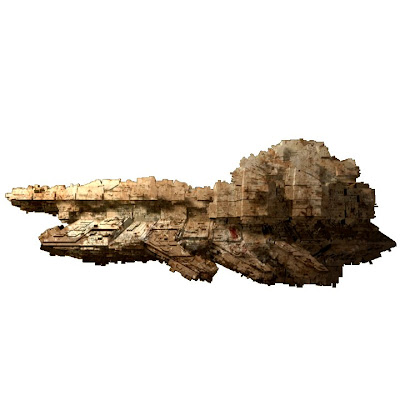
Level Design
 My levels were designed with fast paced gameplay in mind. I decided to keep backgrounds simple because gorgeous backgrounds full of nebulae and singularities would hinder the player from being able to decipher what his challenge is. A simple example is that it would make bullets more difficult to see. However, some simple background elements were added to give certain levels more of a sense of place. The main identifier for a particular level however is that each contains a new type of enemy and each contains a unique boss to battle at the end of each level.

 Controls
Ease of control was another design problem I faced. Often I hear of complaints about cumbersome controls for mobile games. As such, I decided I wanted my control scheme to be flexible by allowing the player to use the whole screen for control, but at the same time, these controls can be reset by simply touching the screen in a new area. To solve this issue, I used a a feature in Unity 3d called raycasting. This allowed me to get the control I wanted and allowed for the control to offset the player's ship so they can see what is going on at all times. The control is made visible whenever the player touches the screen. If the player moves his thumb across the screen, the controller follows. If the player taps on the screen to fire, a second control circle is made visible, the vanishes when the player completes the tap. This may seem complex at first, but it is actually quite simple. In addition, it also allows for left or right handed control of the player's ship.
iOS limitations
When creating a game for iOS, there are some restrictions that must be considered. The first is a 20 megabyte “over the air” download size. This was especially important because my target price range was .99 cents and I wanted this game to be simple to download because of it’s inherent simplicity. The aforementioned decision to use sprite maps helped me to say under the limit.
Secondly, were draw calls. A draw call is basically when the game draws anything visual on the screen. These need to be kept as low as possible. Sprite maps allowed me to batch a great deal of draw calls. As a result, a lot of action is present on the screen without taking a serious hit on performance; Especially with 4th generation iOS devices like the iPhone 4.
Scripting, My greatest challenge
Creating visuals is my primary skillset. However, my desire to see this game finished warranted a better understanding of scripting in Unity3d. I spent a great deal of time learning how to script. At first, I thought the JavaScript would be like scripting for web, but it was the opposite. Using JavaScript in Unity is similar, but it is not quite as tedious as web scripting. I used the Design3 Unity3d scripting tutorials to learn the basics. It took approximately 3 months before I was able to write my own scripts. The Unity Community was also a great help if I ran into issues that I could not work through on my own.
Playtesting
I must have played this game 1000 times. No Joke. I also had a lot of people playtest for me as well. Friends, family, students, random people in a bar and on the train helped me to fine tune my game. One key observation was how long before a person would stop playing the game and give it back. Some would hand it back after the first few seconds and a few would not put it down. I began taking notes about this. Eureka, I found my target audience. It seemed that most people initially thought the game was too hard, but after beating the first boss, their confidence in the game and themselves increased. Apparently, the 3d graphics don’t necessarily translate into a casual gaming experience. Nor do space shooters. But after the first level was defeated, I noticed a change in the attitude toward the game. One interesting tidbit I received as feedback was from a young woman at a bar who asked me, “Am I shooting radioactive avocadoes?” She was referring to the green asteroids.
Submission to Apple
visit the site for Osprey!
Osprey has been released!
Greetings! My solo effort for iOS has been released and is now available on the iPhone app store!
Here is a link to the game's website-
Osprey
Here is the app store link!
Osprey on iTunes
Here is a link to the game's website-
Osprey
Here is the app store link!
Osprey on iTunes
Saturday, April 17, 2010
Wednesday, March 24, 2010
If you are going to be in New Hampshire, I will be doing a training session on ZBrush sculpting for 3D printing.
More info here.
More info here.
Saturday, February 13, 2010
Posed Steve

Here is a low res render of Steve in a pose! Finished the biped rig and binding today!
Next up, some animation!
Rigged Steve

Steve is now rigged and is ready to animate. He is rigged and bound in 3Ds max using biped and physique. I really like how you can assign verts by envelope. The more I use Max, the more I like it. It seems quicker to work with and the modeling tools are much nicer.
Friday, February 12, 2010
Kamodo Steve update

Here is an update for Steve. I am still dialing the texture maps. I will post the texture maps soon. I am really trying to add some polish to this character.
Portable Promise
The exhibition of my video Installation at the William Blizard Gallery is ending soon. Here is the video that I use for it. It is video capture of a level in Unreal. The piece is about combining memorable visual experiences from my life to make something new.
A Portable Promise from Matthew Board on Vimeo.
Saturday, February 6, 2010
Making classes

Today was a challenging day. I made my first 2 classes for a video game that I am working on using the Unreal Developer Kit. Basically, it is Unreal Scripting 101 for me. The cool thing is that the executable file opens the game and the basic controls work. I am not a programmer, my thing is making the art, level design stuff. But, I need to get this under my belt in order to actually make the game. Like most things, it is great when it works.
Sunday, January 31, 2010
Kamodo Steve

Had a chance to work on Steve's textures over the weekend. This is still very much a work in progress, but it's getting there. I am happy with the plunger and the boots so far.
Thursday, January 28, 2010
Super Ramen Brothers at the App Store

 On January 2nd, I did the character art for Super Ramen Brothers. A game for the iPhone that was completed in 24 hours. You can download it for free at the Apple App store! I modeled, textured, rigged and animated the character for the game. I also made the loading screen and app icon. Many thanks to gtjuggler and voxelboy for including me! BTW, my friend Steve Trenkamp made the music. Read more here.
Subscribe to:
Posts (Atom)